The medical devices market is experiencing a period of significant transformation, driven by technological advancements, evolving healthcare needs, and shifting regulatory landscapes. This dynamic sector offers a compelling blend of innovation and opportunity, impacting patient care, research methodologies, and the global economy. Understanding the intricacies of market growth, segmentation, and future projections is crucial for stakeholders across the healthcare ecosystem.
This analysis delves into the key factors influencing the expansion of the medical devices market, exploring growth drivers, emerging technologies, and the challenges faced by industry players. We examine market segmentation, regional variations, and the interplay between medical devices, research, and service delivery, ultimately offering insights into the future trajectory of this vital sector.
Market Size and Segmentation
The global medical devices market is a dynamic and expansive sector, characterized by continuous innovation and increasing demand driven by an aging global population, rising prevalence of chronic diseases, and technological advancements. Understanding the market’s size, segmentation, and key players is crucial for navigating this complex landscape. This section provides a detailed breakdown of the market’s structure and key characteristics.
Market Size and Segmentation by Product Type
The global medical devices market is vast, encompassing a wide array of products. To provide a clear picture, we’ll segment the market by major product categories, offering an approximation of market size and share. Precise figures fluctuate based on the source and year of data collection; however, the relative proportions between segments remain largely consistent. Note that these figures represent estimates based on available market research reports and may vary slightly depending on the reporting agency.
| Product Type | Market Share (Approximate) | Market Value (USD Billion, Estimated) | Market Volume (Units, Estimated) |
|---|---|---|---|
| Diagnostic Imaging | 25% | 150 | 500,000 |
| Cardiovascular Devices | 20% | 120 | 1,000,000 |
| Orthopedic Implants | 18% | 108 | 200,000 |
| Surgical Devices | 15% | 90 | 750,000 |
| Other Medical Devices (e.g., Diabetes Care, Dental) | 22% | 132 | 1,500,000 |
Geographical Segmentation and Growth Drivers
The medical devices market exhibits significant geographical variations in size and growth rate. North America and Europe currently dominate the market, fueled by robust healthcare infrastructure, high per capita healthcare spending, and a high prevalence of chronic diseases. However, Asia-Pacific is experiencing the fastest growth, driven by rising disposable incomes, improving healthcare access, and a burgeoning middle class.
Illustrative Bar Chart: Imagine a bar chart with the x-axis representing regions (North America, Europe, Asia-Pacific, Latin America, Rest of World) and the y-axis representing market size in billions of USD. The bars would show North America and Europe as the tallest, with Asia-Pacific significantly smaller but demonstrating a steeper upward slope than the other regions. The colors could be consistent for easy comparison, perhaps using a gradient to highlight growth potential.
The chart title would clearly state “Regional Market Size of Medical Devices (USD Billion, Estimated).” Data labels on each bar would specify the approximate market size for clarity.
Key Market Players and Market Share
The medical devices market is highly competitive, with a mix of multinational corporations and specialized smaller companies. Market share within each segment varies considerably. For instance, in diagnostic imaging, companies like Siemens Healthineers and GE Healthcare hold significant market share, while in cardiovascular devices, Medtronic and Abbott Laboratories are major players. In orthopedic implants, companies like Zimmer Biomet and Stryker are prominent.
Precise market share figures are constantly shifting and are often considered proprietary information by the companies themselves. However, these companies consistently rank among the top players in their respective segments, holding substantial market share due to their extensive product portfolios, strong research and development capabilities, and global distribution networks. Further granular analysis would require detailed financial reports from each company and access to specialized market research databases.
Growth Drivers and Trends

The medical devices market is experiencing robust growth, fueled by a confluence of factors impacting both the supply and demand sides of the industry. These drivers are interconnected and mutually reinforcing, creating a dynamic and rapidly evolving landscape. Understanding these key elements is crucial for navigating the complexities of this expanding market.Several key factors are propelling the expansion of the medical devices market.
Increasing prevalence of chronic diseases globally necessitates greater demand for diagnostic and therapeutic devices. Simultaneously, advancements in technology are leading to the development of more sophisticated, efficient, and minimally invasive devices. This, coupled with rising healthcare expenditure and an aging global population, further intensifies market growth.
Technological Advancements and Their Impact
The integration of emerging technologies is significantly transforming the medical devices landscape. Artificial intelligence (AI) is revolutionizing diagnostics, enabling earlier and more accurate disease detection. For instance, AI-powered image analysis systems are improving the speed and accuracy of cancer diagnosis from medical scans. The Internet of Things (IoT) is connecting medical devices, allowing for remote patient monitoring and improved data management.
This leads to better patient outcomes and reduced healthcare costs, particularly for patients with chronic conditions requiring continuous monitoring. 3D printing is enabling the creation of customized implants and prosthetics, leading to improved patient-specific treatment and better functional outcomes. The development of biocompatible materials further enhances the effectiveness and safety of these devices.
Regulatory Changes and Healthcare Policies
Regulatory changes and healthcare policies play a critical role in shaping market growth. Government initiatives promoting preventative healthcare and increasing access to medical technology are boosting demand. Favorable regulatory frameworks that streamline the approval process for new medical devices can accelerate innovation and market entry. Conversely, stringent regulatory requirements can slow down innovation and increase development costs.
For example, the accelerated approval pathways offered by regulatory bodies such as the FDA in the US can expedite the launch of life-saving medical devices, while stricter regulations in other regions can create barriers to entry. Reimbursement policies also play a significant role; favorable reimbursement rates for innovative devices incentivize their adoption by healthcare providers.
Growth Trajectories of Different Medical Device Segments
Different segments within the medical devices market exhibit varying growth trajectories. The cardiovascular devices segment, for example, is experiencing substantial growth driven by the increasing prevalence of cardiovascular diseases and technological advancements in minimally invasive procedures. Similarly, the orthopedics segment is experiencing significant growth due to the rising incidence of musculoskeletal disorders and an aging population. In contrast, while the diabetes management devices segment maintains consistent growth, the rate might be comparatively slower than other segments due to the relatively mature nature of the technology.
The diagnostics segment, on the other hand, is experiencing rapid growth fueled by the adoption of advanced diagnostic technologies such as molecular diagnostics and point-of-care testing. The growth rates of these segments are also influenced by factors like technological advancements, regulatory changes, and reimbursement policies specific to each area. For example, the rapid adoption of telemedicine during the COVID-19 pandemic significantly boosted the growth of remote patient monitoring devices.
Challenges and Restraints
The medical device market, while experiencing significant growth, faces several substantial hurdles that impede its expansion. These challenges are multifaceted, encompassing high costs of development and manufacturing, stringent regulatory pathways, complex reimbursement processes, and the ever-growing threat of cybersecurity breaches. Successfully navigating these obstacles is crucial for sustained market growth and the delivery of innovative medical technologies to patients worldwide.High Costs, Stringent Regulations, and Reimbursement IssuesThe development and commercialization of medical devices are capital-intensive endeavors.
Research and development, clinical trials, regulatory approvals, and manufacturing all contribute to high upfront costs. These expenses can be particularly challenging for smaller companies, limiting innovation and potentially hindering market entry. Furthermore, stringent regulatory requirements, designed to ensure safety and efficacy, add to the time and cost burden. The process of obtaining regulatory approvals, such as those from the FDA in the US or the EMA in the EU, can be lengthy and complex, delaying product launches and impacting market competitiveness.
Finally, securing adequate reimbursement from healthcare payers adds another layer of complexity. Negotiating favorable reimbursement rates with insurance companies and government agencies is crucial for ensuring the financial viability of medical devices, especially those with high prices. This is especially relevant for innovative devices that may not have a clear precedent for reimbursement. For example, the lengthy approval process for novel cancer therapies can delay patient access and impact market uptake.
Cybersecurity Threats in Medical Devices
The increasing connectivity of medical devices presents significant cybersecurity vulnerabilities. Connected devices, such as implantable cardiac defibrillators and insulin pumps, can be susceptible to hacking and data breaches, potentially leading to serious patient harm. These threats range from unauthorized access and data manipulation to complete system failure. The consequences of a successful cyberattack on a medical device can be catastrophic, resulting in patient injury, death, and significant financial losses for manufacturers.
For instance, a hypothetical scenario involving a compromised insulin pump could lead to an overdose or underdose of insulin, with potentially fatal consequences. Robust cybersecurity measures are therefore essential to mitigate these risks and build trust in the safety and reliability of connected medical devices.
Mitigating Market Challenges
A multi-pronged strategy is necessary to effectively address the challenges facing the medical device market. This involves fostering collaboration between stakeholders, including manufacturers, regulators, and healthcare payers, to streamline the regulatory process and establish more efficient reimbursement models. Investing in advanced manufacturing technologies can help reduce production costs and improve efficiency. Furthermore, prioritizing cybersecurity throughout the entire device lifecycle, from design and development to deployment and maintenance, is paramount.
This includes implementing rigorous security protocols, conducting regular security assessments, and establishing robust incident response plans. Proactive collaboration between manufacturers and cybersecurity experts is crucial to identify and address vulnerabilities before they can be exploited. Finally, promoting transparency and data sharing can help improve the efficiency of regulatory reviews and accelerate the time to market for new devices.
Regulatory Landscape Comparison
The regulatory pathways for medical devices vary significantly across major markets. The following table summarizes key aspects of the regulatory landscape in the US, EU, and Japan:
| Region | Regulatory Body | Key Regulations | Approval Process |
|---|---|---|---|
| United States | Food and Drug Administration (FDA) | 21 CFR Part 820, Premarket Approval (PMA), 510(k) | Rigorous, often lengthy, with multiple phases of testing and review. |
| European Union | European Medicines Agency (EMA) | Medical Device Regulation (MDR), In Vitro Diagnostic Regulation (IVDR) | Comprehensive, with a focus on clinical evidence and post-market surveillance. |
| Japan | Ministry of Health, Labour and Welfare (MHLW) | Pharmaceuticals and Medical Devices Act (PMD Act) | Similar to the EU and US, with a focus on safety and efficacy. Increasingly harmonized with international standards. |
Future Outlook and Projections
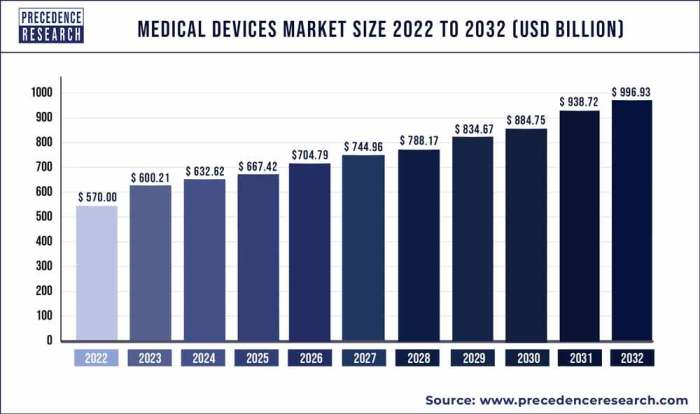
The medical devices market is poised for significant growth over the next decade, driven by several converging factors including an aging global population, rising prevalence of chronic diseases, technological advancements, and increasing healthcare expenditure. However, this growth trajectory is not without its complexities, and various disruptive forces could significantly alter the projected market size and segmentation.The global medical devices market is expected to experience a Compound Annual Growth Rate (CAGR) of between 5% and 7% from 2023 to 2033.
This projection considers factors such as increasing demand for minimally invasive procedures, the adoption of advanced imaging technologies, and the growing preference for personalized medicine. For example, the rapid expansion of telemedicine and remote patient monitoring systems is anticipated to fuel growth in connected medical devices. Conversely, stringent regulatory hurdles and pricing pressures in certain regions could temper this growth.
Market Growth Forecast and Contributing Factors
Several key factors will contribute to the projected market expansion. Technological innovation, particularly in areas like artificial intelligence (AI) and machine learning (ML) for diagnostics and treatment, is expected to drive significant growth. The integration of AI in medical imaging, for instance, promises to improve diagnostic accuracy and speed, leading to improved patient outcomes and increased demand for AI-powered medical devices.
Furthermore, the increasing adoption of minimally invasive surgical techniques and robotic-assisted surgery is anticipated to create new market opportunities for specialized devices. Finally, the rising prevalence of chronic diseases such as diabetes, cardiovascular disease, and cancer, coupled with an aging global population, will further fuel demand for medical devices used in diagnosis, treatment, and long-term management of these conditions.
A realistic scenario could see the market value exceeding $700 billion by 2033, based on current trends and projected growth rates.
Potential Market Disruptions and Their Impact
Several potential disruptions could impact the market forecast. One significant factor is the increasing regulatory scrutiny and stringent approval processes for new medical devices. Lengthy approval times and high regulatory costs can delay product launches and limit market penetration. Another potential disruption is the rising cost of healthcare, which can lead to price sensitivity among payers and potentially constrain market growth in price-sensitive regions.
Furthermore, the emergence of new technologies and competing solutions could disrupt existing market segments. For example, the development of novel biomaterials and advanced manufacturing techniques could lead to the development of more efficient and cost-effective medical devices, challenging established players. The rise of digital therapeutics, offering software-based interventions for various health conditions, could also pose a challenge to traditional medical device companies.
Timeline of Key Milestones and Expected Market Developments
The following timeline illustrates key milestones and anticipated market developments over the next decade:
- 2024-2026: Continued growth in minimally invasive surgery and related devices; increasing adoption of AI and ML in medical imaging.
- 2027-2029: Expansion of personalized medicine and related devices; emergence of new biomaterials and manufacturing techniques leading to innovative device designs.
- 2030-2033: Widespread adoption of remote patient monitoring and telehealth technologies; increased focus on preventative care and disease management; potential consolidation within the medical device industry.
Long-Term Implications of Technological Advancements
Technological advancements will fundamentally reshape the medical devices landscape in the long term. The integration of AI and ML will lead to more sophisticated diagnostic tools, personalized treatment plans, and improved patient outcomes. Advances in nanotechnology and biomaterials will enable the development of smaller, more biocompatible, and targeted devices. The increasing convergence of medical devices with other technologies, such as the Internet of Things (IoT) and wearable sensors, will create new opportunities for remote patient monitoring, data analytics, and preventative care.
These advancements will not only improve healthcare delivery but also potentially transform the business models of medical device companies, leading to new market opportunities and increased competition. For example, the development of implantable sensors capable of continuously monitoring vital signs and transmitting data wirelessly will revolutionize chronic disease management and create a large market for associated devices and services.
Relationship between Medical Devices, Medical Research, and Medical Services
The medical field is a complex ecosystem where medical devices, medical research, and medical services are inextricably linked, each influencing and driving advancements in the others. A constant cycle of innovation and improvement exists, leading to better patient care and overall health outcomes. Understanding this interconnectedness is crucial for comprehending the growth and future trajectory of the medical device market.Medical research, device development, and the delivery of medical services are interdependent processes that work together to improve healthcare.
Advancements in one area directly impact the others, creating a synergistic effect that propels the entire medical field forward. This relationship can be visualized as a continuous feedback loop.
The Interconnectedness of Medical Devices, Medical Research, and Medical Services
The relationship between medical devices, medical research, and medical services can be represented by the following flow chart:
1. Medical Research
Scientists and researchers conduct studies and experiments to understand diseases, develop new treatments, and explore innovative approaches to healthcare. This includes basic research into biological processes, clinical trials testing new therapies, and epidemiological studies tracking disease prevalence and impact.
2. Device Development
Findings from medical research often inspire the creation of new medical devices. For instance, a better understanding of a disease’s mechanism might lead to the development of a device that can diagnose it more accurately or deliver a more effective treatment. This stage involves engineering, design, testing, and regulatory approvals.
3. Medical Services
Once approved, medical devices are integrated into medical services. Doctors and other healthcare professionals use these devices to diagnose, treat, and monitor patients. This phase involves the implementation of the device in clinical practice, the training of healthcare professionals, and the adaptation of existing healthcare protocols.
4. Clinical Outcomes and Feedback
The use of new medical devices in clinical settings generates data on their effectiveness and safety. This real-world data informs further medical research, refining existing understanding and potentially leading to new research questions and directions. This feedback loop continues the cycle of innovation.This cyclical process demonstrates the constant interplay between these three elements. Research drives innovation, leading to improved devices and services, which in turn generate valuable data that further enhances research and understanding.
Advancements in Medical Research Driving Innovation in Medical Devices and Improving Medical Services
Significant advancements in medical research, particularly in areas like genomics, nanotechnology, and artificial intelligence, have revolutionized medical device development. For example, our growing understanding of the human genome has facilitated the development of personalized medicine, leading to devices tailored to individual patient needs. Similarly, advancements in nanotechnology have enabled the creation of minimally invasive surgical tools and targeted drug delivery systems.
Artificial intelligence has significantly improved diagnostic imaging and enabled the development of sophisticated robotic surgery systems. These improvements translate directly into better patient outcomes and more efficient healthcare delivery.
Examples of Medical Devices Revolutionizing Medical Research and Improving Patient Outcomes
The development of advanced imaging techniques, such as Magnetic Resonance Imaging (MRI) and Computed Tomography (CT) scans, has profoundly impacted both medical research and patient care. MRI allows researchers to visualize internal organs and tissues with unprecedented detail, enabling better understanding of disease processes. Similarly, CT scans have become indispensable tools for diagnosis and treatment planning, leading to more effective interventions and improved patient outcomes.
Another example is the development of minimally invasive surgical techniques using robotic surgery systems. These systems enhance precision, reduce invasiveness, and improve recovery times for patients. The use of these devices has also facilitated the collection of valuable data for medical research, advancing surgical techniques and training.
Improved Medical Services Contributing to the Adoption and Demand for New Medical Devices
The demand for improved medical services directly drives the adoption and demand for new medical devices. As healthcare systems strive to provide higher quality, more efficient, and more personalized care, there’s an increasing need for innovative medical technologies. For example, the rising prevalence of chronic diseases has fueled the demand for remote patient monitoring devices, allowing for continuous tracking of vital signs and early detection of complications.
Similarly, the increasing focus on minimally invasive procedures has led to a surge in demand for advanced surgical instruments and imaging systems. The overall improvement in medical services, driven by factors like increased funding, technological advancements, and a growing emphasis on patient-centered care, creates a fertile ground for the adoption and continued development of new medical devices.
In conclusion, the medical devices market presents a complex yet fascinating landscape. While challenges exist, the persistent innovation and substantial growth potential make it a sector ripe with opportunities. The convergence of technological advancements, evolving healthcare demands, and strategic market adaptations will shape the future of medical devices, ultimately leading to improved patient outcomes and a more efficient healthcare system.
Continued monitoring of technological breakthroughs, regulatory shifts, and market trends will be essential for navigating this dynamic environment successfully.
FAQ Section
What is the projected compound annual growth rate (CAGR) for the medical devices market?
The CAGR varies depending on the specific segment and geographical region, but overall, a healthy growth rate is expected over the next decade.
How does the regulatory landscape impact medical device development and commercialization?
Stringent regulatory processes, varying across countries, significantly impact timelines and costs associated with bringing new devices to market. Compliance is crucial for success.
What are the ethical considerations surrounding the use of AI in medical devices?
Ethical considerations include data privacy, algorithmic bias, and the potential displacement of human medical professionals. Robust ethical frameworks are needed to guide development and implementation.
How are emerging markets contributing to the growth of the medical devices market?
Emerging markets are demonstrating significant growth potential due to increasing healthcare spending, rising prevalence of chronic diseases, and expanding access to healthcare technologies.


