Medical research plays a pivotal role in understanding and treating mental health disorders. Recent advancements have significantly improved our understanding of the brain’s complexities, leading to innovative diagnostic tools and therapeutic approaches. This exploration delves into the current landscape of mental health research, examining breakthroughs in neuroscience, the impact of medical devices, and the translation of research findings into improved patient care.
We will also consider future directions and the challenges that remain in this critical field.
From groundbreaking genetic studies illuminating the roots of schizophrenia to the development of sophisticated brain stimulation therapies, the field is constantly evolving. This examination considers the ethical implications of new methodologies, the challenges of translating research into clinical practice, and the crucial need for improved access to mental healthcare services. The intersection of medical research, devices, and services is explored, highlighting their synergistic potential for enhancing mental health outcomes.
The Intersection of Medical Research, Medical Devices, and Medical Services in Mental Health

Advancements in medical research are fundamentally reshaping our understanding and treatment of mental health conditions. This progress is significantly amplified by parallel developments in medical devices and the delivery of medical services, creating a powerful synergy that is improving patient outcomes. The integration of these three areas – research, devices, and services – is crucial for translating scientific discoveries into tangible benefits for individuals struggling with mental illness.
The impact of this interconnectedness is profound. Medical research provides the foundation of knowledge, identifying biological mechanisms, developing diagnostic tools, and evaluating therapeutic interventions. Medical devices then translate this knowledge into practical applications, offering innovative technologies for diagnosis, monitoring, and treatment. Finally, medical services ensure the effective and accessible delivery of these advancements to patients, bridging the gap between research findings and real-world clinical practice.
Advancements in Medical Devices Impacting Mental Health Research and Clinical Practice
The development of sophisticated medical devices is revolutionizing mental health care. For instance, neuroimaging techniques like fMRI and EEG provide detailed insights into brain activity, enabling researchers to better understand the neural underpinnings of various mental disorders. These technologies are not only used for research purposes but also inform clinical diagnosis and treatment planning. Wearable sensors, such as smartwatches and activity trackers, allow for continuous monitoring of physiological data, including sleep patterns, heart rate variability, and activity levels – all of which can be valuable indicators of mental health status.
Furthermore, transcranial magnetic stimulation (TMS) and deep brain stimulation (DBS) are increasingly used as therapeutic interventions for treatment-resistant depression and other conditions. These devices offer targeted and non-invasive methods to modulate brain activity, offering new hope for patients who have not responded to traditional therapies.
The Role of Medical Services in Translating Research Findings into Improved Patient Outcomes
Medical services play a vital role in translating the findings of medical research and the capabilities of medical devices into tangible improvements in patient outcomes. Effective dissemination of research findings to clinicians through continuing medical education programs, publications, and professional conferences is essential. Moreover, the integration of new technologies and therapies into routine clinical practice requires well-trained healthcare professionals, accessible infrastructure, and appropriate reimbursement policies.
The accessibility and affordability of mental health services, including access to specialists, medication, and therapy, are crucial factors determining whether research breakthroughs can benefit a wider population. Furthermore, robust data collection and analysis within clinical settings are necessary to monitor treatment effectiveness and inform future research.
The Synergistic Relationship Between Medical Research, Medical Devices, and Medical Services in Advancing Mental Healthcare
The relationship between medical research, medical devices, and medical services is inherently synergistic. Research generates the knowledge that drives the development of new devices and therapies. These devices and therapies are then implemented and evaluated within clinical practice, generating further data that informs future research. This iterative process of discovery, innovation, and implementation is crucial for continuous improvement in mental healthcare.
For example, research on the effectiveness of a new antidepressant medication (research) leads to its development and approval (medical services). The medication is then delivered to patients (medical services), and its effects are monitored and studied (research), potentially leading to refinements in the medication or the development of new treatment strategies.
Visual Representation of the Interconnectedness of Research, Devices, and Services
Imagine a three-circle Venn diagram. Each circle represents one of the three areas: medical research, medical devices, and medical services. The overlapping areas represent the synergistic interactions. The central overlapping area, where all three circles intersect, represents improved mental health outcomes. Arrows could be drawn connecting the circles to illustrate the flow of information and resources.
For example, an arrow from the “medical research” circle to the “medical devices” circle would show how research findings lead to device development. Another arrow from “medical devices” to “medical services” would illustrate how new devices are integrated into clinical practice. Finally, an arrow from “medical services” back to “medical research” demonstrates the feedback loop where clinical data informs future research directions.
The size of the central overlapping area would visually emphasize the significant impact of the synergistic relationship on improving patient outcomes.
Future Directions in Mental Health Research
The field of mental health research stands at a pivotal moment, poised for significant advancements due to converging technological innovations and a growing understanding of the brain’s complexities. Future research efforts will need to focus on refining existing treatments, developing novel therapeutic approaches, and improving access to care. This requires a multi-faceted approach encompassing biological, psychological, and social factors.
Promising Areas of Future Research in Mental Health
Three particularly promising areas for future research include personalized medicine approaches to mental health treatment, the investigation of the gut-brain axis’s role in mental illness, and the exploration of novel therapeutic targets within specific brain circuits implicated in mental disorders. Personalized medicine aims to tailor treatments to individual genetic and environmental factors, maximizing efficacy and minimizing side effects. Research into the gut-brain axis focuses on the bidirectional communication between the gut microbiome and the brain, recognizing the potential for manipulating gut microbiota to positively influence mental health.
Finally, the exploration of novel therapeutic targets in specific brain circuits promises more precise and effective interventions by targeting the root causes of mental disorders at a neurological level. For example, research targeting specific neurotransmitter pathways or inflammatory processes within the brain could lead to the development of more effective medications with fewer side effects.
The Potential of Artificial Intelligence and Machine Learning in Advancing Mental Health Research and Treatment
Artificial intelligence (AI) and machine learning (ML) offer transformative potential for mental health research and treatment. AI algorithms can analyze vast datasets of patient information, identifying patterns and risk factors that may be undetectable by human analysis alone. This enhanced diagnostic accuracy could lead to earlier interventions and improved treatment outcomes. For example, AI-powered tools can analyze speech patterns, facial expressions, and text messages to detect subtle signs of mental distress, enabling timely intervention.
Furthermore, ML algorithms can be used to personalize treatment plans by predicting individual responses to different therapies, optimizing treatment strategies for each patient. This personalized approach could significantly improve treatment efficacy and reduce the trial-and-error process often associated with mental healthcare. Moreover, AI-powered chatbots and virtual assistants could provide readily available support and monitoring, improving access to mental health services, particularly in underserved communities.
Challenges and Opportunities in Conducting Large-Scale, Multi-Site Mental Health Research Studies
Conducting large-scale, multi-site mental health research studies presents considerable challenges, but also significant opportunities. Challenges include harmonizing data collection methods across different sites, ensuring data quality and consistency, and managing the complexities of coordinating research efforts across multiple institutions. The sheer volume of data generated also requires robust data management infrastructure and sophisticated analytical techniques. However, the potential rewards of such studies are substantial.
Large-scale studies allow for the identification of subtle effects that might be missed in smaller studies, providing a more comprehensive understanding of mental illness etiology and treatment response. Multi-site studies also enhance generalizability, ensuring that findings are applicable to diverse populations. For example, a large-scale, multi-site study could investigate the effectiveness of a new treatment across different demographic groups and geographical locations, providing strong evidence of its efficacy and generalizability.
Potential Solutions to Improve Data Sharing and Collaboration in Mental Health Research
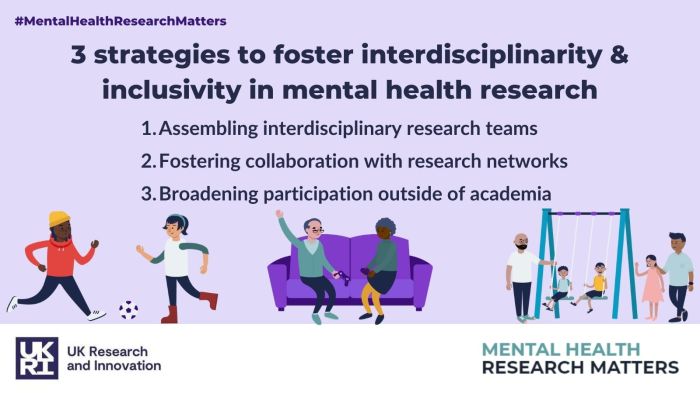
Improving data sharing and collaboration in mental health research requires a multi-pronged approach. The development of standardized data formats and ontologies is crucial for ensuring interoperability and facilitating data integration across different studies. This standardization allows researchers to combine data from multiple sources, creating larger, more powerful datasets for analysis. Furthermore, the establishment of secure, centralized data repositories, with robust data governance frameworks, can facilitate data sharing while protecting patient privacy.
These repositories could provide researchers with access to a wealth of data, accelerating research progress and enabling more collaborative research projects. Finally, fostering a culture of open science and data sharing within the mental health research community is paramount. Incentivizing data sharing through appropriate recognition and rewarding collaboration can encourage greater participation and promote the efficient use of research resources.
This collaborative approach will be critical to accelerating advancements in mental health research and improving the lives of those affected by mental illness.
In conclusion, medical research is undeniably transforming the landscape of mental health care. While significant progress has been made, ongoing challenges remain, including bridging the gap between research and clinical practice, ensuring equitable access to care, and addressing the ethical considerations inherent in emerging technologies. Continued investment in research, coupled with collaborative efforts among researchers, clinicians, and policymakers, is essential to further advance the field and ultimately improve the lives of individuals affected by mental illness.
User Queries
What are the limitations of current mental health research?
Limitations include funding constraints, challenges in recruiting diverse populations for studies, difficulties in replicating findings, and the complexity of accurately measuring subjective experiences.
How can I participate in mental health research?
Many research studies recruit participants. You can find opportunities by searching online clinical trial databases or contacting research institutions directly.
What is the role of technology in mental health research?
Technology is rapidly advancing the field, enabling large-scale data collection, analysis, and the development of personalized treatment approaches through AI and machine learning.
What is the difference between TMS and ECT?
Transcranial magnetic stimulation (TMS) uses magnetic pulses to stimulate brain regions, while electroconvulsive therapy (ECT) involves brief electrical currents to induce a controlled seizure. ECT is generally reserved for severe cases unresponsive to other treatments.


